
My Friends,
I thought this may help some, as my research into this topic, way back when Tom Bearden said to Research this, really made very little sense. Now, after years of study, this makes perfect sense!
This report provides a true and correct technical explanation of the provided diagram, detailing how the work of E.T. Whittaker reformulates the electromagnetic process within a single-coil generator, including an analysis of the vector fields and the integration of Lenz's Law from this perspective.
Technical Report: Whittaker’s Reformulation of Electrodynamics Applied to a Single-Coil Generator
1. Introduction
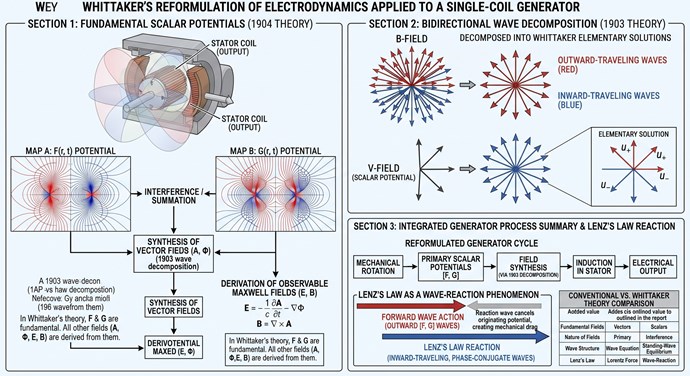
The diagram, "WHITTAKER'S 1903 & 1904 CONCEPTS APPLIED TO A SINGLE-COIL GENERATOR" (Image 2), illustrates a fundamental re-interpretation of electromagnetic induction. Conventional theory, based on Maxwell's initial formulation, describes induction using macroscopic vector fields ($\mathbf{E}$, $\mathbf{B}$) and potentials ($\mathbf{A}$, $\Phi$).
This diagram shows that the entire process can be deconstructed and derived from deeper, scalar-based principles established by E.T. Whittaker in his 1903 and 1904 papers. This view posits that the observable vector fields are not fundamental, but are instead interference patterns of underlying scalar potential structures.
2. Section 1: 1904 Scalar Potentials (F, G) Mapping
This section demonstrates that the entire vector electromagnetic field ($\mathbf{A}, \Phi, \mathbf{E}, \mathbf{B}$) of the generator can be synthesized from just two scalar functions.
The Components and Progress:
- The Generator System: A simple AC generator is shown, with a single Rotor Coil rotating inside a single, fixed Stator Coil (Output Coil).
- The Primary Potentials (F, G): The system's electromagnetic function is first mapped not by $\mathbf{E}$ or $\mathbf{B}$, but by two independent scalar potential fields, labeled $F(r, t)$ and $G(r, t)$.
- Map A ($F$-field): This map shows the equipotential lines of the first Whittaker scalar potential emanating from the rotor. It is depicted with a specific topology, perhaps corresponding to a longitudinal or compressional scalar mode.
- Map B ($G$-field): This map shows the equipotential lines of the second scalar potential. Crucially, its topology is spatially distinct and "orthogonal" (in function, not just space) to the $F$-field.
- Interference / Summation: The core of this reformulation is that the observable vector fields are not generated directly by charge or current alone. Instead, the $F$ and $G$ fields interfere and sum at every point in space.
- Synthesis of Vector Fields: This scalar interference pattern gives rise to the conventional vector potential fields:
- The Magnetic Vector Potential, $\mathbf{A}$
- The Electric Scalar Potential, $\Phi$
- Recovery of Maxwell's Field Vectors: Once the potentials $\mathbf{A}$ and $\Phi$ are established via scalar interference, the standard observable field vectors are derived from them using the defining equations (shown in the blue box):
$\mathbf{E} = -\frac{1}{c}\frac{\partial\mathbf{A}}{\partial t} - \nabla\Phi$ (Electric Field)
$\mathbf{B} = \nabla\times\mathbf{A}$ (Magnetic Induction)
In conventional theory, $\mathbf{A}$ and $\Phi$ are derived from currents and charges, and then $\mathbf{E}$ and $\mathbf{B}$ are derived from $\mathbf{A}$ and $\Phi$. In Whittaker's theory, $F$ and $G$ are fundamental, and all other fields (A, $\Phi$, E, B) are derived from them.
3. Section 2: 1903 Bidirectional Wave Decomposition of B and V
This section refines the mechanism, explaining the intrinsic structure of the fields themselves, linking them to Whittaker's 1903 work.
The Components and Process:
- Deconstruction of the B-field: The diagram isolates the $\mathbf{B}$-Field (Magnetic Induction) produced by the rotor coil. Conventionally, this is a simple vector. Whittaker's 1903 paper proved that any static or standing wave field (like the $\mathbf{B}$-field) can be mathematically decomposed into an infinite set of inward- and outward-propagating null-mass plane waves.
- Whittaker's Elementary Solutions: This decomposition is visualized as a star-burst of arrows. The $\mathbf{B}$-field is shown to be a standing-wave synthesis of:
- Outward-traveling waves (red arrows)
- Inward-traveling waves (blue arrows)
- Deconstruction of the V-field: The same principle is applied to the $\mathbf{V}$-Field (Scalar Potential), such as the static potential from the rotor's charge. This is also shown to be decomposable into inward ($u_+$) and outward ($u_-$) wave pairs, with the elementary solutions shown in the inset plot.
- Implication (Lenz's Law Integration): This bidirectional structure is key to understanding Lenz's Law from a Whittaker perspective.
- Forward Action: The generator rotor creates an outward-propagating potential wave structure ($F, G$) that synthesizes the $\mathbf{B}$-field.
- Lenz's Law Reaction: When the stator coil experiences this changing field and an induced current flows, it creates its own opposing field. In this advanced view, the opposing stator field is not just a force; it is an inward-traveling wave (a "phase-conjugate" or "time-reversed" wave) that propagates back toward the rotor, canceling or reacting against the potential structure that caused the induction. This explains the mechanical drag on the rotor as a direct wave-interference phenomenon.
4. Synthesis: Generator Process Summary
The flowchart at the bottom right summarizes the complete, reformulated process:
- Mechanical Rotation: The input energy creates physical motion.
- Potentials [F, G]: Motion, in the presence of charge, generates the fundamental scalar potentials $F$ and $G$.
- Field Synthesis: The potentials $F$ and $G$ interfere (via the 1903 decomposition principle) to synthesize the intermediate vector fields $\mathbf{A}$ and $\Phi$.
- Induction in Stator: The synthesized $\mathbf{A}$ and $\Phi$ fields (or more fundamentally, the $F$ and $G$ waves themselves) act upon the electrons in the stator coil.
- Electrical Output: This induction causes current flow.
- (Implicit) Lenz's Law Feedback: The stator current creates a reaction field (an inward-traveling wave) that propagates back to the rotor, completing the energy loop.
5. Conclusion: Added Value vs. Conventional Theory
Compared to the original conventional theory, which is a phenomenological model (describing what happens), Whittaker's reformulation provides an ontological model (describing why it happens) by going one layer deeper.
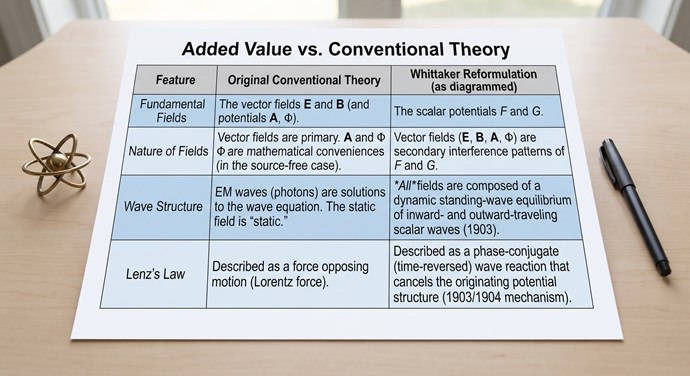
The Whittaker approach reveals a "hidden variable" layer of electrodynamics, suggesting that electromagnetism is fundamentally a scalar, longitudinal wave phenomenon, and the transverse vector fields are merely its observable effects.
Technical Report: Conventional Transformer Theory (Maxwell-Heaviside Formulation)
1. Introduction
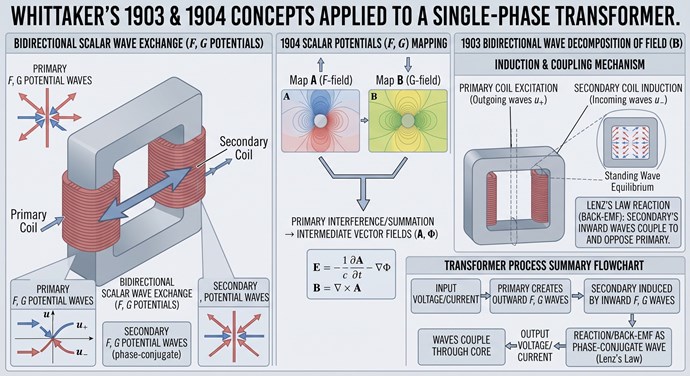
This report provides the standard, phenomenological explanation of electromagnetic induction as applied to a conventional iron-core transformer, based on the Maxwell-Heaviside equations. This perspective describes the operation of the device using macroscopic vector fields ($\mathbf{E}$, $\mathbf{B}$, $\mathbf{A}$) and scalar potentials ($\Phi$), which are treated as fundamental physical quantities within the accepted framework of classical electrodynamics.
2. Section 1: 1904 Vector Fields (A, B) and Scalar Potentials ($\Phi$) Mapping
This section demonstrates that the entire electromagnetic field of the transformer is generated by the dynamics of charge (current) within the coils, mediated by the magnetic properties of the core.
The Components and Process:
- The Transformer System: A conventional transformer consists of a Primary Coil (Input) and a spatially separate Secondary Coil (Output), both wound around a high-permeability ferromagnetic core.
- The Primary Action (Generation): A time-varying current, $I_1(t)$, flows in the Primary Coil. This current acts as the source of the electromagnetic field.
- Fundamental Source (Current): According to Maxwell's equations, the current $I_1$ generates a Magnetic Field, $\mathbf{B}$, defined by the Biot-Savart law or Ampere's Law (with displacement current).
- Coupling Mechanism (Flux): The ferromagnetic core dramatically concentrates the magnetic field lines, creating a confined Magnetic Flux, $\Phi_B$, that threads through both the Primary and Secondary coils.
- Faraday's Law (Induction): Since the current $I_1(t)$ is time-varying, the resulting Magnetic Flux, $\Phi_B(t)$, is also time-varying. According to the Maxwell-Faraday equation:
$\nabla \times \mathbf{E} = -\frac{\partial \mathbf{B}}{\partial t}$
This changing magnetic field, $\frac{\partial \mathbf{B}}{\partial t}$, curls around and induces a circulating Electric Field, $\mathbf{E}_{ind}$, in the space surrounding the flux.
- Secondary Action (Voltage Generation): This induced Electric Field, $\mathbf{E}_{ind}$, acts upon the free electrons within the Secondary Coil wire. This creates an electromotive force (EMF) or voltage, $V_2(t)$, at the secondary terminals, proportional to the number of turns ($N_2$) and the rate of change of flux: $V_2 = -N_2 \frac{d\Phi_B}{dt}$.
- Potentials (Mathematical Convenience): In this conventional view, the potentials ($\mathbf{A}, \Phi$) are derived mathematical tools, not fundamental physical causes. The Magnetic Vector Potential, $\mathbf{A}$ (where $\mathbf{B} = \nabla \times \mathbf{A}$), and Electric Scalar Potential, $\Phi$ (where $\mathbf{E} = -\nabla\Phi - \frac{\partial\mathbf{A}}{\partial t}$), are defined from the source currents and charge distributions to simplify certain calculations.
3. Section 2: The Bidirectional Nature of Power Transfer
This section explains the mechanism of power flow and energy conservation within the transformer.
The Components and Process:
- Forward Power Transfer: The time-varying current in the Primary Coil creates a changing magnetic flux, which induces a voltage and causes current to flow in the Secondary Coil. Energy is transferred from the source, through the fields, to the load.
- Energy Conservation (Lenz's Law): This principle dictates that the effects of induction must oppose the cause.
- Lenz's Law in a Transformer: When a load is connected to the Secondary Coil and current $I_2(t)$ flows, this secondary current generates its own magnetic field ($\mathbf{B}_2$). By Lenz's Law, this secondary field, $\mathbf{B}_2$, must be in the opposite direction to the original primary field, $\mathbf{B}_1$.
- Magnetic "Back-Reaction": This opposing field, $\mathbf{B}_2$, tends to demagnetize or cancel out the net flux established by the Primary Coil. This cancels the change in flux that is causing the induction, creating a self-regulating system.
- Primary Compensation (reflected impedance): To maintain the magnetic flux (which is linked to the applied primary voltage), the Primary Coil must draw additional current from the source. This is the "reflected load" phenomenon. This back-EMF from the secondary reaction directly causes the primary circuit to provide more power, satisfying the conservation of energy (Input Power $\approx$ Output Power).
4. Synthesis: Transformer Process Summary
The complete conventional process is summarized as follows:
- Primary Current (Input): Time-varying current flows in the Primary Coil.
- Generates Fields (B, E): This current is the source that directly generates the Magnetic Field $\mathbf{B}$, which is concentrated by the iron core.
- Induction (d$\Phi$/dt): The time-varying magnetic flux ($\Phi_B$) induces a circulating Electric Field $\mathbf{E}$ throughout the core and coils.
- Secondary EMF: This induced Electric Field acts on the electrons in the Secondary Coil.
- Secondary Current (Output): The resulting secondary voltage causes current to flow, transferring energy to the load.
- Lenz's Law Reaction: The secondary current generates an opposing magnetic field, creating a reactive back-EMF that causes the primary coil to draw more power from the source to sustain the core flux.
5. Conclusion: Value of the Conventional Theory
The conventional Maxwell-Heaviside theory provides a robust, mathematically self-consistent, and highly practical model for designing and analyzing transformers and all other electromagnetic devices. It successfully describes the phenomena of induction, energy transfer, and the self-regulating nature of these systems using observable vector fields as its foundational elements. It is the cornerstone of electrical engineering.
Best Wishes,
Chris