
My Friends,
We have covered Voltage in Many Places!
Voltage as a Scalar Value is equivalent to 6.241509 x 10¹⁸ Electrons, as is the Coulomb, and One Ampere is this same number, moving past point P1 in one second.
We have covered previously, that the Differential Mode Choke filters out Voltage Transients by, what I call Un-Generating Voltage, in Electrical Engineering, this is just called 'a filter'🙄
I am sure most of you have done the experiment, and it is well known, Bucking Coils don't allow you to Generate any Voltage, which is well known in the Auto Transformer Step Down configuration.
The Auto Transformer
In an autotransformer, "windings that are wound and connected non-inductively" typically refers to special arrangements (often bifilar or opposing windings) where the magnetic fields from current-carrying sections largely cancel each other out. This minimizes net inductance for certain currents or paths, preventing unwanted voltage drops, inductive effects, or interference while still allowing the transformer to function. The phrase "this ungenerates voltage" likely means that these sections produce no net induced voltage (or minimal self-induced EMF) due to the cancellation, unlike standard inductive windings.
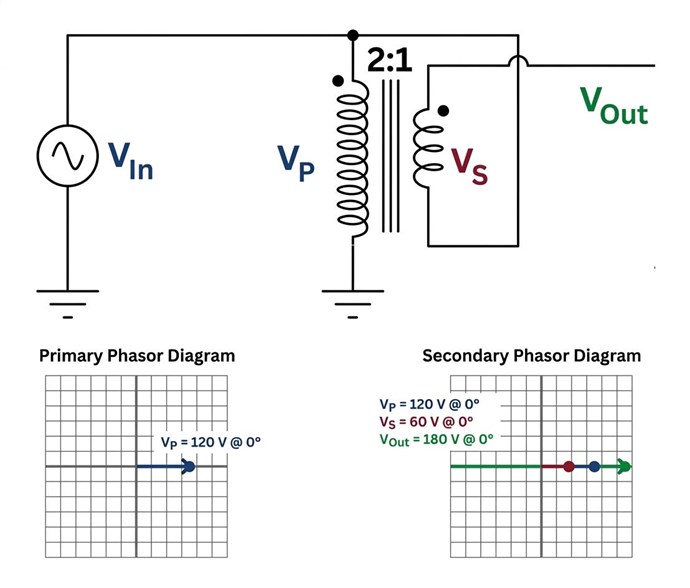
This image depicts a step-up autotransformer configured for boost (adding) voltage.
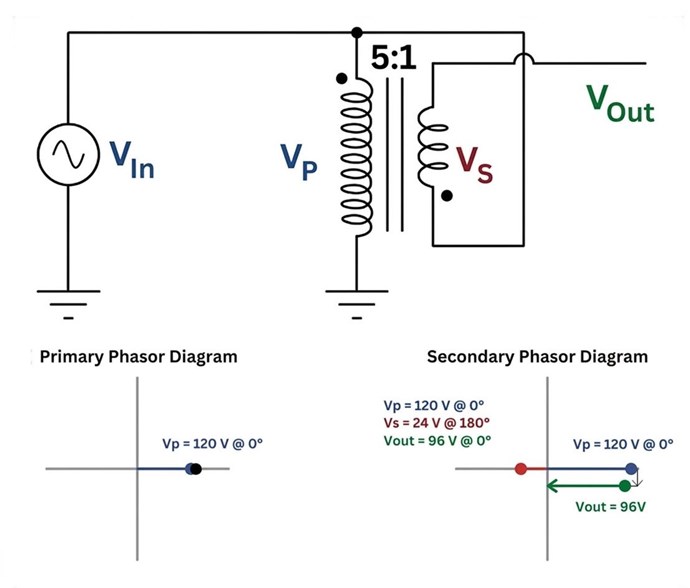
This image depicts a step-down autotransformer configured for bucking (subtracting) voltage.
Why This Is a Step-Down Configuration
Subtractive Polarity: Unlike your first example where the secondary added to the primary, this circuit is wired so the secondary voltage (\(V_s\)) opposes the primary voltage (\(V_p\)). You can see this in the Secondary Phasor Diagram, where the red dot (\(V_s\)) is on the opposite side of the axis relative to the input.
With a 5:1 ratio, the 120V input (\(V_p\)) creates a 24V secondary (\(V_s\)). Because it is bucking the main voltage, the total output is:
\[ V_{out} = V_p - V_s = 120\,\text{V} - 24\,\text{V} = 96\,\text{V} \]
Result: Since \(96\,\text{V}\) is less than the input \(120\,\text{V}\), it is functionally a step-down (buck) operation.
How an Autotransformer Works
An autotransformer is a special type of electrical transformer that uses a single continuous winding acting as both primary and secondary. A portion of the winding is common to both input and output circuits, unlike conventional transformers that have electrically isolated separate windings.
Basic Operating Principle
The voltage transformation depends on the turns ratio. If the total turns from one end to the other is \(N\) and the common/tap section has \(N_1\) turns, the relationship is:
\[ \frac{V_{out}}{V_{in}} = \frac{N_{out}}{N_{in}} \]
Bucking (Step-Down) Mode Explained
In the buck configuration:
- The secondary portion of the winding is connected in series opposition (subtractive polarity) to the supply voltage.
- The voltage induced in the secondary section (\(V_s\)) opposes the input voltage (\(V_p\)).
- Only the difference between the two voltages appears across the load.
For the 5:1 ratio example:
\[ V_s = \frac{1}{5} \times 120\,\text{V} = 24\,\text{V} \] \[ V_{out} = V_p - V_s = 120\,\text{V} - 24\,\text{V} = 96\,\text{V} \]
Key Advantages
• More efficient power transfer because part of the power flows conductively through the common winding.
• Smaller size and lower cost compared to a conventional two-winding transformer of similar rating.
• Ideal for small voltage adjustments (buck or boost).
This autotransformer setup efficiently reduces the voltage from 120 V to 96 V using the bucking configuration shown in the image.
Key Advantages of Autotransformers
• Only a small portion of the power is transferred inductively (transformer action).
• The rest is transferred conductively through the common winding.
• Higher efficiency and smaller physical size compared to conventional transformers of the same rating.
This explains why the circuit produces a stepped-down output of 96 V from a 120 V supply in a bucking autotransformer setup.
Conclusion
We have an Applied Voltage of 120 Volts, but the Step Down Voltage is 96 Volts. So the Quantity of Electrons is Reduced, Choked off simply by using Bucking Coils. This is what I call Un-Generating a Voltage, again, the Differential Mode Choke works the same way.
Un-Generating Voltage literally means that the 6.241509 x 10¹⁸ Electrons x 120 has reduced to 6.241509 x 10¹⁸ Electrons x 96. We have Un-Generated 24 Volts, or to 6.241509 x 10¹⁸ Electrons x 24 Volts.
Now, if we have a Reduction using one Configuration, how do we get an increase using another configuration?
Best Wishes,
Chris